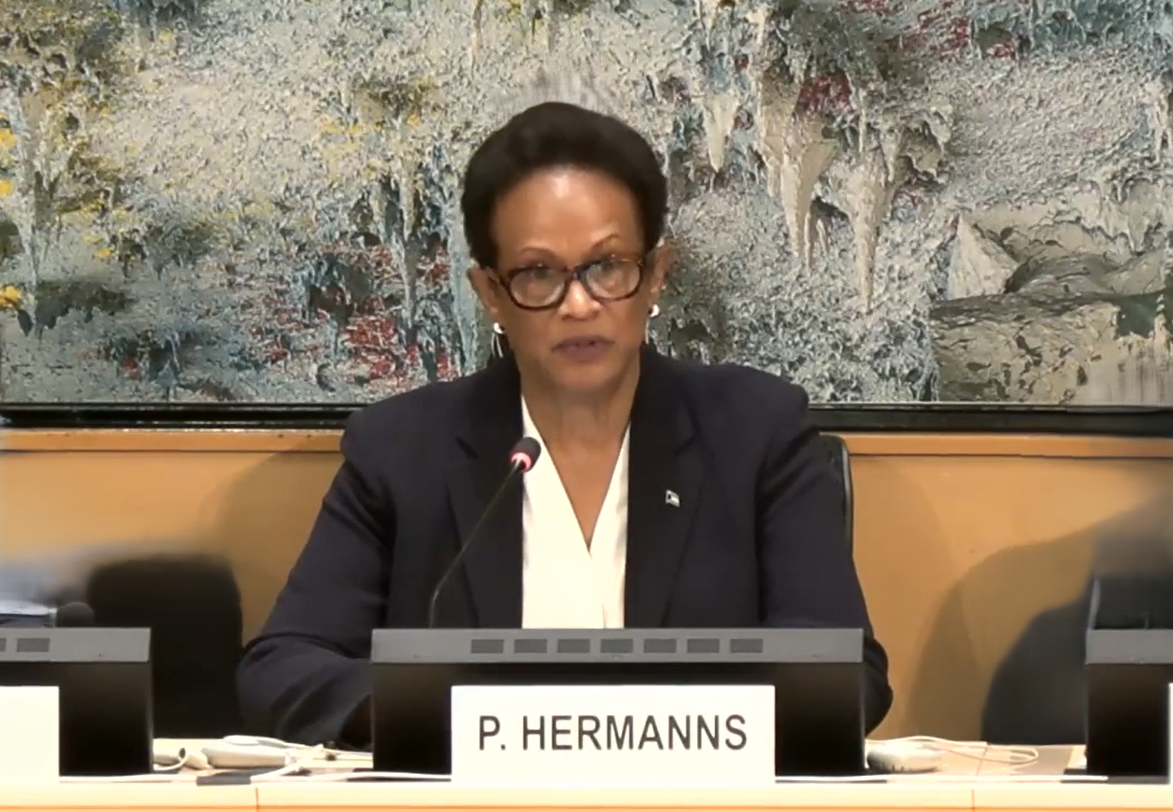
Geneva, Switzerland — The Bahamas has called for stronger international cooperation and a human rights-centred approach to climate finance, emphasizing that Small Island Developing States (SIDS) continue to bear the greatest consequences of a climate crisis to which they have contributed the least.
Speaking during the panel discussion on the Adverse Impacts of Climate Change on Human Rights at the 62nd Session of the United Nations Human Rights Council, H.E. Patricia A. Hermanns, Ambassador and Permanent Representative of The Bahamas to the United Nations Office and other International Organizations in Geneva, underscored that the impacts of climate change on the enjoyment of human rights should no longer be a matter of debate given that they are a lived reality for climate-vulnerable States.
Echoing the words of Prime Minister Philip Davis that The Bahamas carries “the scars of this injustice,” Ambassador Hermanns described climate inequality as the stark disconnect between minimal responsibility for global emissions and the disproportionate risks faced by vulnerable countries. The Ambassador noted that climate change continues to threaten a wide range of fundamental human rights, including the rights to life, health, food, water and sanitation, housing, culture, development and self-determination.
Ambassador Hermanns welcomed the International Court of Justice’s Advisory Opinion, issued in July 2025, which affirmed that States have binding obligations under international law to prevent dangerous climate change, protect human rights affected by climate impacts and cooperate internationally. The opinion, Ambassador Hermanns further noted, reinforces the longstanding position of climate-vulnerable countries that addressing climate change requires not only national action but also meaningful international cooperation, through adequate climate finance, technology transfer, capacity-building, adaptation support and financing for loss and damage.
Highlighting the growing financing gap faced by vulnerable countries, the Ambassador stressed that climate finance should be viewed not as an act of charity but as an international legal and human rights imperative. While welcoming the establishment of the Loss and Damage Fund, Her Excellency expressed concern that current pledges remain far below the level required to provide meaningful support to countries experiencing the devastating impacts of climate change.
The Bahamas therefore called for climate finance that is new, additional, predictable, accessible, adequate, grant-based and non-debt creating. The statement also urged reforms to the international financial architecture, including expanded concessional financing, debt relief for climate-vulnerable countries, greater use of Special Drawing Rights, and the full capitalization of the Loss and Damage Fund.
Ambassador Hermanns further emphasized that access to climate finance should be determined by vulnerability rather than income classification alone. In this regard, The Bahamas advocated for the operationalization of the Multidimensional Vulnerability Index across financing decisions, debt sustainability assessments and access to concessional resources to better reflect the realities facing Small Island Developing States.
Underscoring the country’s own commitment to innovative climate action, Ambassador Hermanns highlighted The Bahamas’ Debt Conversion Project for Marine Conservation, as well as the enactment of the Climate Change and Carbon Initiatives Act and the Carbon Credit Trading Act. These initiatives are designed to expand fiscal space while supporting marine conservation, food security, resilient infrastructure, social protection and a just transition, with safeguards to ensure environmental integrity and community benefit.
Concluding the intervention, Ambassador Hermanns reaffirmed that predictable and accessible climate finance, strengthened international cooperation and meaningful representation of vulnerable countries in global decision-making are essential to advancing human rights in the face of climate change. Her Excellency stressed that, if these commitments are fulfilled, climate finance can become a bridge from crisis to resilience, enabling vulnerable nations to pursue sustainable development while safeguarding the dignity and rights of their people.
Here is the full video courtesy of the UN Human Rights Council