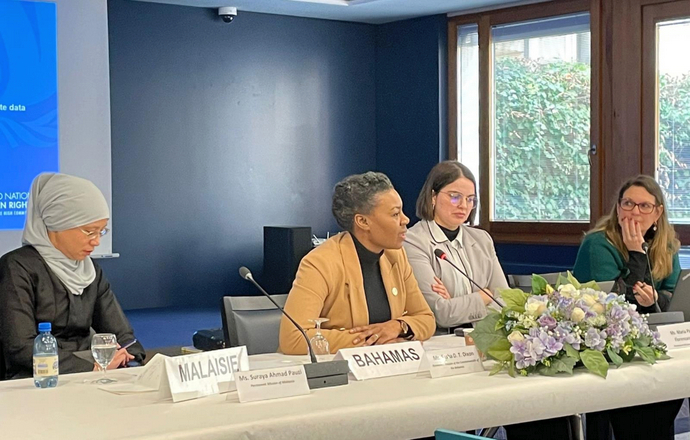
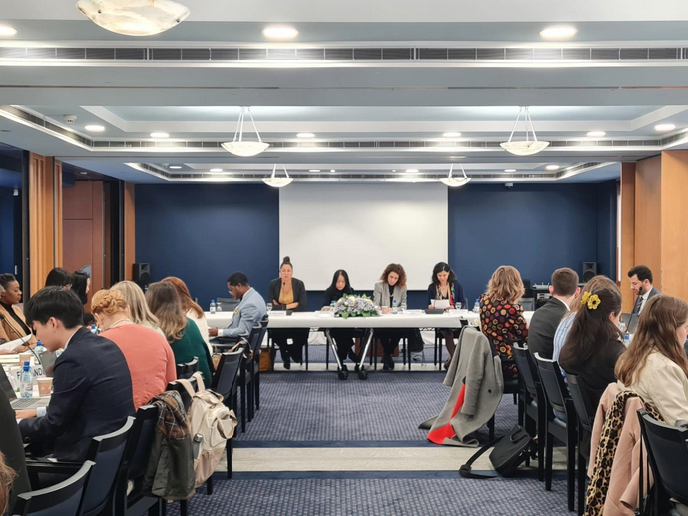
 The Bahamas participated in the full-day Policy Dialogue entitled “Paving the Way for the Fifth Universal Periodic Review Cycle,” held on 19 November 2025 at the Permanent Mission of Thailand in Geneva. The event was organised by UPR Info together with the Permanent Missions of Spain, Switzerland and Thailand, with support from Morocco, Norway and the Office of the High Commissioner for Human Rights.
Bringing together representatives of Member States, UN entities, civil society and development partners, the Dialogue served as an important platform to reflect on the future of the Universal Periodic Review (UPR) mechanism as the international community approaches the end of its fourth cycle. Discussions focused on strengthening the mechanism’s effectiveness, enhancing implementation of recommendations, and promoting the exchange of good practices.
Representing The Bahamas, Ms. Sasha D. T. Dixon, Counsellor at the Permanent Mission in Geneva, served as Moderator of Session 2, dedicated to exploring ways to improve the implementation of UPR recommendations. In her opening remarks, Ms. Dixon underscored that implementation lies “at the heart of the credibility of the UPR” and highlighted the importance of fostering enabling environments for the protection, respect and fulfilment of human rights.
Drawing on the national experience of The Bahamas and the country’s long-standing engagement in the UPR, Ms. Dixon noted the essential role of National Mechanisms for Implementation, Reporting and Follow-Up (NMIRFs), the value of multi-stakeholder national dialogue, and the importance of strengthening data systems to measure progress. She also highlighted the contribution of well-crafted, action-oriented recommendations and the growing inclusion of frontier issues such as climate change within UPR discussions.
Panellists from Malaysia, Chile, and OHCHR presented national and institutional perspectives on good practices, challenges and emerging approaches for ensuring more effective implementation of recommendations. An interactive exchange followed, during which participants reflected on opportunities for leveraging each stage of the UPR cycle, improving reporting of measurable human rights impact, and enhancing access to technical cooperation and capacity-building.
In closing the session, Ms. Dixon thanked all panellists and participants, emphasising that as preparations for the fifth UPR cycle begin, implementation must remain the central focus to ensure that the mechanism continues to deliver meaningful improvements for individuals and communities worldwide.