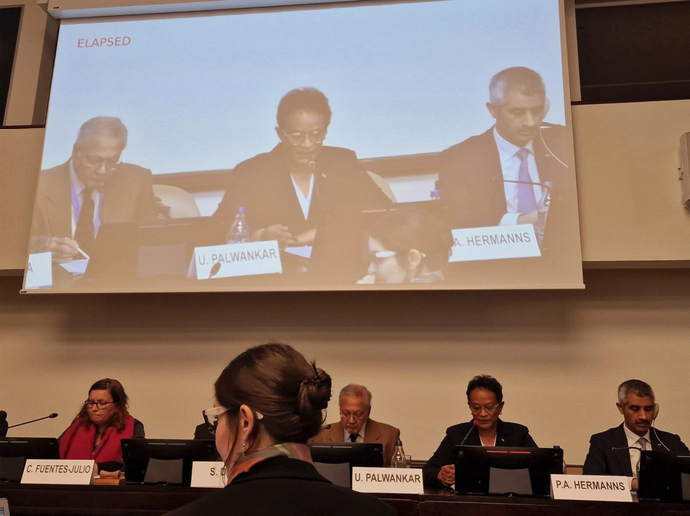
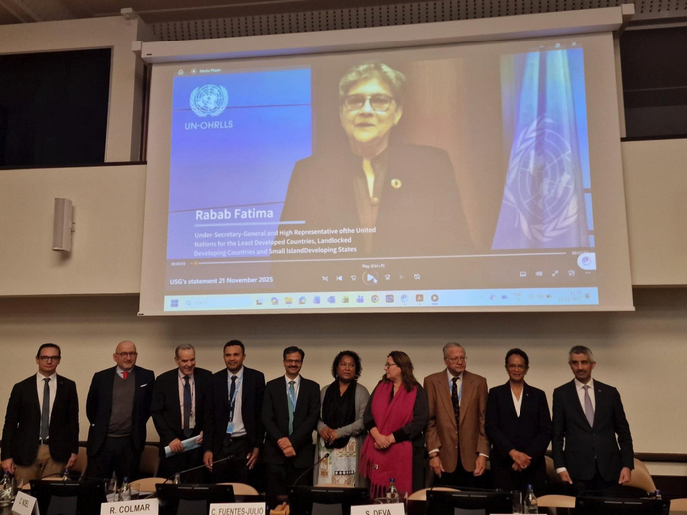
 The Commonwealth of The Bahamas underscored the urgent need for a more equitable global response to climate change during the International Conference on Climate Inequality, Human Rights and Sustainable Development, held at the Palais des Nations. The meeting, convened by the UN Special Rapporteur on the Right to Development and the Geneva Centre for Human Rights Advancement and Global Dialogue, gathered diplomats, senior officials, experts and representatives from across the international community.
Speaking during the High-Level Opening Session, H.E. Patricia A. Hermanns, Ambassador and Permanent Representative of The Bahamas to the United Nations Office and other International Organizations in Geneva, emphasised that climate inequality remains one of the most pressing human rights and development challenges of our time, particularly for Small Island Developing States (SIDS).
“SIDS collectively account for less than one per cent of global greenhouse gas emissions, while bearing some of the gravest impacts of climate change,” Ambassador Hermanns stated. “This is the essence of climate inequality: the gap between minimal responsibility and maximal risk.”
Ambassador Hermanns recalled the devastating impacts of Hurricane Dorian (2019), which erased nearly a quarter of The Bahamas’ GDP, and the more recent Hurricane Melissa (2025), which affected over five million people across the Caribbean. She stressed that repeated shocks, limited fiscal space and protracted recovery periods continue to threaten human rights, including the right to development.
The Bahamas welcomed recent judicial developments from the Inter-American Court of Human Rights and the International Court of Justice, which reaffirm that States have obligations to prevent, remedy and cooperate internationally to reduce climate-related damage and to do so in accordance with equity and the principle of common but differentiated responsibilities and respective capabilities.
Highlighting structural financing inequities, The Bahamas pointed to the persistent misalignment between climate vulnerability and access to concessional finance. Ambassador Hermanns welcomed the Multidimensional Vulnerability Index (MVI) as a tool to better reflect the realities of developing countries and called for deeper reform of the international financial architecture, building on the outcomes of the Sevilla Commitment adopted at the Fourth International Conference on Financing for Development.
She urged the international community to adopt shock-responsive financial mechanisms, including standardised debt-pause clauses for countries struck by natural disasters; accessible and affordable liquidity facilities and expanded grant-based climate finance, particularly for adaptation and loss and damage.
“…if support arrives mostly as debt, the burden on vulnerable economies will deepen,” she cautioned.
Ambassador Hermanns outlined national efforts to widen fiscal space and mobilise resources in support of human rights and development. The Bahamas has enacted the Climate Change and Carbon Initiatives Act and the Carbon Credit Trading Act to govern blue-carbon credits and other innovative mechanisms, ensuring environmental integrity and community benefit.
“These innovative financing mechanisms are viewed as complementary to, and not a replacement for, predictable public climate finance and concessional funding,” she said, emphasising that climate-related revenues in The Bahamas will be channelled into food security, resilient infrastructure, social protection and a just transition.
The Bahamas urged that global commitments—including those in the Pact for the Future, the Geneva Consensus, and the Baku to Belém Roadmap—must translate into decisions that genuinely reduce climate inequality.