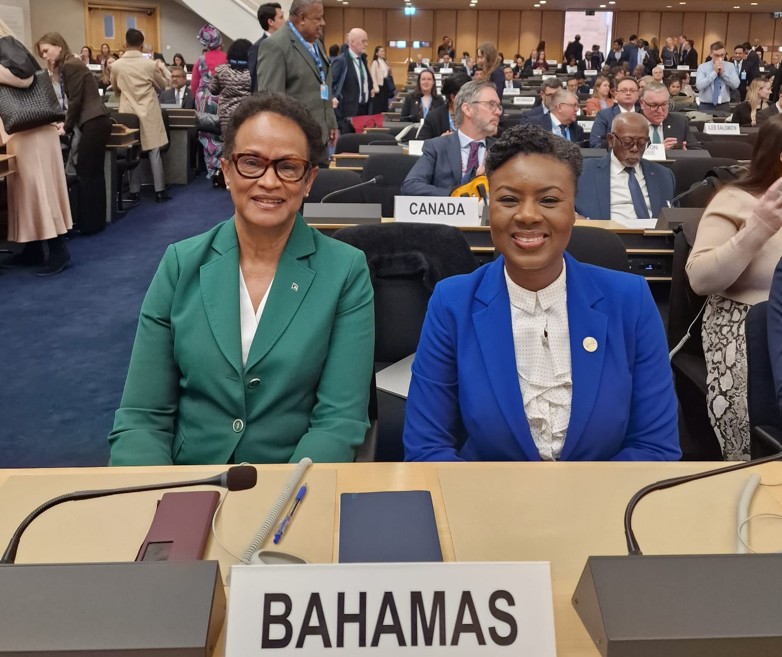
The Bahamas participated in the High-Level Segment of the 61st session of the Human Rights Council, held from 23 to 25 February 2026 at the Palais des Nations in Geneva. The High-Level Segment brought together Heads of State and Government, Ministers, and Senior Officials to reaffirm their commitment to the promotion and protection of human rights amid mounting global challenges.
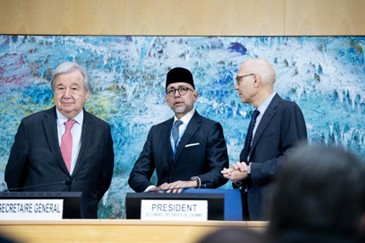
On 23 February, the High Commissioner for Human Rights, Volker Türk, the Secretary-General of the United Nations, António Guterres, and the President of the General Assembly, Annalena Baerbock, delivered remarks underscoring the gravity of the current global human rights landscape. The Secretary-General emphasised that indifference from observers compounds suffering and reaffirmed that the tools of the Human Rights Council are more essential than ever in addressing global crises. The President of the General Assembly drew attention to the systematic erosion of rights and stressed that oppressive systems rarely collapse in a single moment but erode gradually through collective pressure and action, urging States to recognise that silence and inaction are themselves choices. The High Commissioner echoed the urgency of collective action, emphasising the indivisibility and interdependence of all human rights. He encouraged a coalition between nations, able to capture the palpable energy of grassroots movement to reaffirm human rights and dignity and represent the quiet majority.
On the margins of the High-Level Segment, Ambassador Patricia A. Hermanns and Counsellor Sasha Dixon participated in the official reception marking the topping-out ceremony of the new “Portail des Nations,” the future United Nations Geneva Visitor Centre, held on 23 February near the flag walkway at the Palais des Nations. The ceremony symbolised the continued renewal and accessibility of the United Nations presence in Geneva and was attended by ministerial delegations also participating in the High-Level Segment.
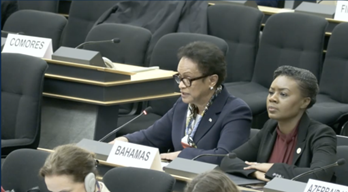
On 24 February, Ambassador Hermanns delivered a statement on behalf of the Caribbean Community (CARICOM) Member States in Geneva during the High-Level Panel commemorating the twenty-fifth anniversary of the adoption of the Durban Declaration and Programme of Action. She underscored that racism remains deeply rooted in the legacies of slavery, the transatlantic slave trade and colonialism, and that the social and economic effects of these human rights violations are compounded by the disproportionate effects of climate change felt by the Bahamas and the Caribbean Community. She highlighted that the Durban Declaration called on the international community “not merely to prune the visible branches of discrimination, but to confront its roots.”
The Ambassador reaffirmed CARICOM’s commitment to confronting structural discrimination and advancing reparatory justice, emphasizing ongoing efforts to update CARICOM’s Ten-Point Plan for Reparatory Justice and to advance cooperation through the Africa–CARICOM Summit process, calling for policies and partnerships that enable affected communities to thrive.
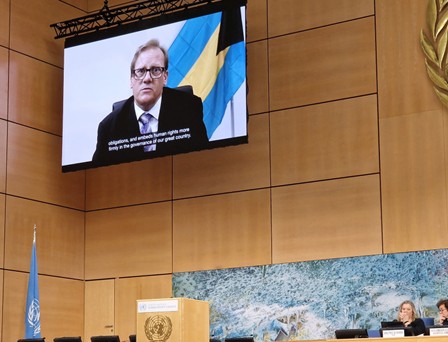
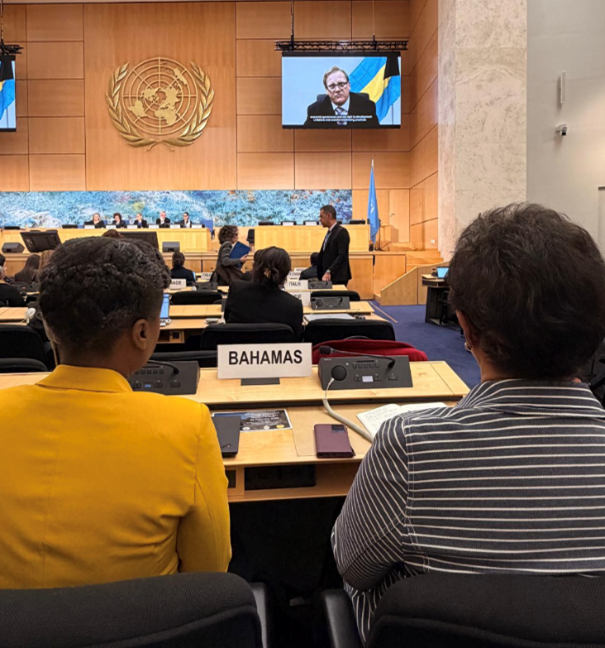
On 25 February, the Attorney-General and Minister of Legal Affairs of The Bahamas, Senator the Hon. L. Ryan Pinder, KC, addressed the Council. Framing human rights as a shared moral compass and multilateralism as the North Star guiding States through turbulent geopolitical waters, he emphasised that for Small Island Developing States (SIDS), adherence to international law is not merely a preference but a protection. He highlighted the existential human rights implications of climate change for The Bahamas and fellow SIDSs, welcomed the Council’s recent work on sea-level rise, and called for scaled-up ambition, financing and solidarity.
The Attorney-General further addressed regional concerns, reaffirmed The Bahamas’ commitment to advancing the rights of People of African Descent, and highlighted the importance of technical assistance.
In closing, Attorney-General Pinder announced that The Bahamas will, for the first time, seek election as a non-permanent member of the United Nations Security Council for the 2032–2033 term under the theme “Resilience, Relationships, Representation,” reflecting the conviction that the voices of Small Island Developing States must be heard and that human rights, climate change and security are inextricably linked.
Through its active engagement during the High-Level Segment, The Bahamas reaffirmed its steadfast commitment to multilateralism, the rule of law, and the promotion and protection of human rights for all.