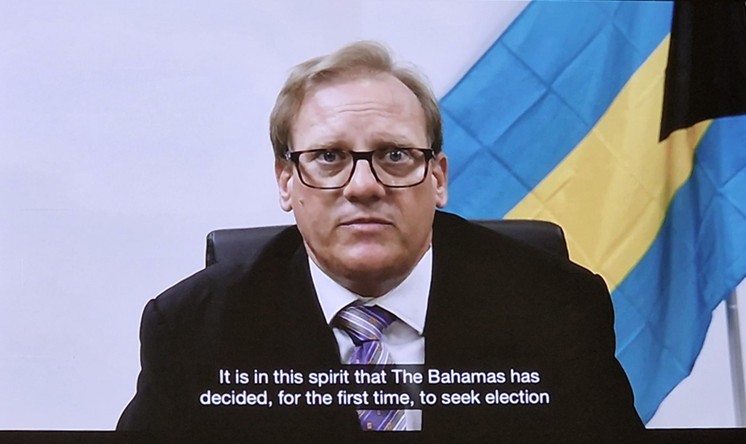
“In turbulent times, the world looks to the United Nations for principled leadership, clarity, fairness, and consistency,” Pinder said in a pre-recorded statement to the 61st session of the United Nations Human Rights Council (UNHRC).
“It is in this spirit that The Bahamas has decided, for the first time, to seek election as a non-permanent member of the United Nations Security Council for 2032–2033, under the theme ‘Resilience, Relationships, Representation’.
“Our candidature reflects the conviction that SIDS voices must be heard, and that human rights, climate change, and security are inextricable.”
Pinder said the recognition and protection of human rights is imperative, particularly in times of “unsettled geopolitical waters, marked by conflict and declining trust,” as he called for a global recommitment to a rules-based order, which helps to protect small nations.
“International law is the great equalizer — the assurance that every vessel, large and small, can set sail with its rights and sovereignty respected,” he said.
Pinder said this ties directly to the climate crisis, which disproportionately impacts The Bahamas and other small island developing states.
“Climate change is already transforming where and how our people live, threatening livelihoods, food security, and the very land beneath our feet,” he said.
“Its human rights consequences demand urgent, collective action.”
He noted that while The Bahamas welcomes the council’s work in the area, more must be done to “scale up ambition, finance, and solidarity”.
“Those who contributed least must not bear the heaviest burdens,” he said.
Pinder also called for fairness in global economic governance and countries’ right to development, raising concerns over “unilateral and coercive” blacklisting practices that disproportionately affect small island states.
“We, therefore, reaffirm the importance of advancing a United Nations Framework Convention on international tax cooperation that is transparent and grounded in equal participation,” he said.
As it relates to regional challenges, Pinder reiterated The Bahamas’ commitment to maintaining the Caribbean as a zone of peace — something that has become contentious with the US’ actions in Venezuela and now Cuba.
He also cited ongoing turmoil in Haiti, which he said is “of profound concern”.
“We welcome the forthcoming operationalization of the Gang Suppression Force and will continue to support and facilitate efforts in this regard,” Pinder said.
“We encourage sustained engagement by the council and the high commissioner, with emphasis on institutional strengthening, civilian protection, and Haitian-led solutions.”
Pinder said The Bahamas remains committed to working with all partners to ensure the UNHRC “stands as a lighthouse for the world – pointing us always toward the ports of justice, peace, and hope”.
“The waters before the international community are rough, but small island states know that panic is not a strategy, and power alone does not guarantee safe passage,” he said.
“What carries us forward is discipline, cooperation, and adherence to the instruments that guide us.”
Full article available at The Nassau Guardian. Video courtesy of UN Web TV